KO Million Login: Game Rules and Winning Strategies
Before the first punch, the numbers deserve attention. This page sets out the return rate, how each difficulty setting changes the swings, the default betting limits and the per-round payout ceiling, then shows how seeds and the bet history let you confirm a result. Theme, challengers and safer play come afterwards, once the maths is on the table.
Experience the thrill of KO Million, a crash game that offers a unique betting experience where players can earn up to 20,000 times their wager.
In summary
KO Million is a crash game developed by InOut Games, featuring a medium-high volatility and a return to player of 95.45%. With betting ranges from zero point twelve to two hundred, players can test their luck with the demo.
How a round works
- How a cash-out works — To play KO Million, begin by placing your wager within the allowed range.
- Making your initial bet — Next, monitor the multiplier as it increases with time.
- Timing your cashout decision — At any point, decide when to cash out before the multiplier resets.
Game Details
| Game type | KO Million |
|---|---|
| Wagering options | 0.12 – 200 |
| Developer | InOut Games |
| Risk level | Medium-high |
| Top payout | 20,000x |
| Launch date | June 2026 |
| Category | Crash-style game |
| RTP | 95.45% |
KO Million puts a single decision in front of you after every punch, which is exactly why its published figures deserve a calm look before any money changes hands. Return rate, spread of results, betting limits and the ceiling on one payout all shape what KO Million can and cannot do.
So the numbers lead here. Theme, challengers and difficulty settings follow once the arithmetic is settled.
In short: the long-run return sits at 95.45%. Volatility moves with whichever mode you select. Default bets per round range from A$0.2 up to A$330, and the most any one round can hand back is A$33,000. Outcomes can also be audited afterwards, through a provably fair setup that lives inside the game itself.
None hints at what the next round holds. They draw the outline, nothing more.
Treat them like a contract's small print: read slowly, and first. Someone who already understands the ceiling, the betting limits and what the mode changes is rarely caught off guard by a session, even a poor one.
RTP of KO Million
KO Million publishes a return to player of 95.45%. Across a vast number of rounds, the game is engineered to give back that proportion of all money wagered. Whatever is left over forms the house margin.
This only holds at scale. It is an average drawn from millions of rounds played by countless people, so it barely speaks to a single evening. A brief session might land well above that mark or far beneath it, and the maths accepts both without blinking.
Think of RTP as a trait of the game rather than a prediction about you. A losing streak does not bend it. Collecting at some special moment earns no reward from it, and a quiet hour leaves it owing you nothing.
What it does offer is an idea of what entertainment costs here. Over many sessions, a slice of every wager stays with the house, and nothing decided during play shifts that long-run share.
Note the 95.45%, then put it to one side. Inside a session, three things carry real weight: your bet, your mode and the instant you choose to walk away.
Volatility set by the mode
Where RTP measures the overall return, volatility describes how wins are scattered. KO Million gives it no fixed label; instead, it hinges on the difficulty setting chosen before a round begins.
Easy occupies the gentle end. With 30 steps it offers the longest climb, and its top multiplier is the lowest of the four, so rewards stay modest and the swings feel softer.
Move away from Easy and volatility climbs with each harder setting. Medium, Hard and Hardcore all trim the number of steps while stretching the multiplier scale enormously. Hardcore goes furthest, squeezing 18 steps between x1.44 at one end and x3,608,855.25 at the other.
Higher volatility usually feels like long dry stretches punctuated by the odd large result. Your balance lurches in bigger jumps, upward and downward, and a session can turn on a few rounds.
None of the four is superior. Picking one simply means picking how much turbulence you accept. On a tight budget, the gap between Easy and Hardcore becomes obvious within minutes.
Stake range
KO Million ships with a default betting window per round, bounded below by A$0.2 and above by A$330. You fix the amount before the first punch, and that sum is what the multiplier works on when you collect.
Operators may adjust those limits, so one site could show a narrower or wider window than another. Look at the minimum and maximum displayed in the game where you actually play instead of relying on the standard figures.
A sharper question than what the game permits is what your budget permits. A sensible bet is small enough that losing one round feels like a single result among dozens, not a dent in the whole evening. If one knockout would hurt, scale down.
Holding the amount steady also keeps a session legible. Adjusting it after every outcome blurs how much has truly gone out.
The A$33,000 Payout Limit
Each KO Million round has a hard ceiling. A win is limited to A$33,000, however large the multiplier glowing on screen when you collect.
That ceiling bites hardest on the tougher settings. Their upper multipliers grow so steep that, across plenty of bet sizes, the number displayed outstrips the sum actually paid. The path keeps rising; the payment does not.
An illustration helps here. With A$1.7 on the line in Hardcore mode, the ceiling arrives long before the top multiplier ever would. This example exists only to show how the limit meets a very long scale. No particular step is implied to hold any particular value, and it is no target.
One consequence matters a great deal. After a round crosses the point where the ceiling kicks in, every extra punch adds danger without adding money. A knockout there still wipes out the full bet, while the possible reward has already stopped growing.
Know the limit before pairing a bet size with a mode. Hunting the biggest multipliers on Hard or Hardcore may look attractive, yet the amount paid stays capped all the same, at every bet size and on every setting.
How a payout is worked out
The sum behind each win is brief. Take your bet, multiply it by whatever multiplier is showing when you collect, and that is the payout, provided it stays under the A$33,000 ceiling.
For a concrete illustration, picture A$0.33 collected at x40: the return comes to A$13. That x40 serves only to demonstrate the arithmetic and points to no specific step, mode or likely result.
The figure returned is the whole amount, bet included. Should a knockout end the round instead, nothing comes back, and the full bet disappears whatever the multiplier stood at a second earlier.
This lopsided trade defines the whole experience. Every step dangles a slightly bigger multiplier, and every step risks everything placed on that round. A figure on screen only turns into money once collected.
Choosing a collection point before the opening punch, then honouring it, tends to help. Hasty calls made midway up a climb are usually the ones people regret.
Provably fair in KO Million
Rounds of KO Million rely on a provably fair method, so any result can be examined once play has ended. Everything required is built in: server and client seeds sit in the settings, while earlier rounds stay available for inspection through the bet history.
A straightforward routine for auditing one round:
- Before playing, open the settings and find both seeds.
- Write them down, giving yourself a record taken before anything happened.
- Play normally, with demo credits or real funds, until the round closes through collection or knockout.
- Head to the bet history and pick out that finished round.
- Read through the details stored for it and set them against the seeds you recorded earlier.
- Run the same check on a different round from time to time, so auditing turns into routine.
All of this serves transparency. Seeds let any outcome be linked back to information that existed before play started, so nobody has to rely on trust alone.
Be clear about the limits of verification, though. Auditing confirms a past round was fair. It reveals nothing about upcoming rounds, and no seed, record or pattern can forecast where a knockout falls.
No bonus round, no bonus buy
There is no bonus round anywhere in KO Million, and since no bonus buy exists, nothing extra can be purchased either. Nothing triggers free rounds, no side game appears, and no button sells a shortcut into a special feature.
Each round follows one script: a bet, a climb of punches, and a choice between collecting and carrying on. Round one looks exactly like round one thousand.
There is a practical upside. With nothing tucked behind a feature, the published numbers describe everything. RTP, mode scales, betting limits and ceiling form the full story.
Should any website or message hint at secret bonus modes for this title, be wary. They do not exist.
The game in brief
KO Million comes from InOut Games, which released this instant title in 2026. Powering it is Step Multiplier, a mechanic developed by the studio, which places KO Million among crash games, where a multiplier climbs until the player collects or loses the bet.
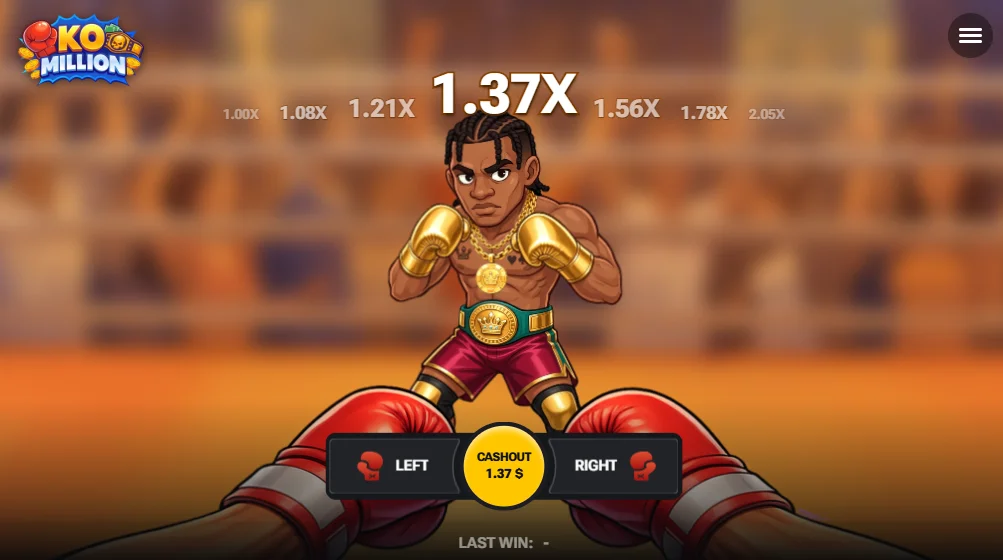
The scene is a boxing bout viewed through your own eyes. Four challengers wait in turn, each one carrying an emblem on the belt; the four emblems are lion, snake, crown and skull.
Every difficulty setting comes with a dedicated boxer and a distinct multiplier scale, so switching modes alters both the fighter facing you and the numbers ahead.
Being an instant game, it involves no reels and nothing to line up. Rounds are short, the rules fit into one sentence, and the only skill involved is knowing when to stop.
Two names are worth keeping apart. InOut Games is responsible for building KO Million. A casino is what offers it to you, carries the licence, manages accounts and processes payments. Questions about deposits, withdrawals or limits belong with the casino, never the studio.
A Single Round of Play
Each round opens at x1.00. First you choose a bet and a mode, which together decide your opponent and the scale ahead.
Every punch lifts you a single step higher and nudges the multiplier upward. Easy begins with a tiny first step; on Hardcore it is noticeably bigger. Whichever setting you chose, the climb continues until the scale ends.
At any step, a knockout may land. If it does, play stops instantly and the bet is gone entirely, however far the multiplier had risen.
Your other option is collecting. That is allowed at any instant, and the multiplier on display is applied to your bet right then. Here lies the entire tension of KO Million: one further punch for a bigger number, or the certainty already on screen.
Continuous play is also available. Hold down the spacebar at a keyboard, or rest a finger on the Play button when on a phone, and punches arrive one after another without pause. They carry on until you release to stop, or until a knockout closes the round. Because it runs so fast, it becomes easy to forget how high you have climbed, so it suits people who settled on a stopping point beforehand.
KO Million rounds never lean on each other. A long climb last time does not make this round safer, and an early knockout does not make it kinder. Previous outcomes hold no clue about upcoming ones.
Four modes and their paths
Each setting carries a fixed count of steps and a fixed spread of multipliers. Below are the published values for KO Million.
- Facile : 30 étapes, avec x1.01 à la base et x23.24 au sommet. La montée la plus longue avec le plus petit sommet, adaptée à ceux qui souhaitent un mouvement plus calme dans l'équilibre et une sensation douce pour comprendre le comportement de l'échelle.
- Moyen : 25 étapes, x1.08 en bas, x2,457 juste au sommet. Cinq étapes de moins que Facile, avec un sommet beaucoup plus élevé. La volatilité augmente nettement ici, et les étapes supérieures atteignent déjà bien plus que ce que Facile peut offrir.
- Difficile : 22 étapes, avec x1.18 à la base et x62,162.09 au sommet. Une montée plus courte et beaucoup plus raide. À de nombreuses tailles de mise, la partie supérieure entre en collision avec le plafond par tour, donc ce qui est payé peut ne pas atteindre le multiplicateur affiché.
- Hardcore : 18 étapes, x1.44 en bas, x3,608,855.25 juste au sommet. La montée la plus brève et les oscillations les plus sauvages des quatre. Son sommet dépasse de loin ce que le plafond autorise à toute taille de mise, ce qui fait de A$33,000 la vraie limite supérieure de ce réglage.
Quelques points s'appliquent à chaque réglage :
- Chaque round de KO Million commence à x1.00 avant de passer à la première étape du mode sélectionné.
- Les knockouts peuvent survenir à n'importe quelle étape, sur n'importe quel réglage.
- Des réglages plus difficiles engendrent des oscillations plus larges, pas un meilleur retour.
- Vous pouvez changer de réglage entre les rounds, mais aucun mode ne peut être chronométré pour attraper une série gagnante.
Choisissez calmement, en gardant le budget en tête. Passer à Hardcore parce qu'une session se passe mal figure parmi les moyens les plus rapides d'aggraver la situation.
Jeu démo dans KO Million
De nombreux opérateurs proposent une version démo gratuite de KO Million. Elle se joue de la même manière que la version payante, avec des modes correspondants, des échelles identiques et la même décision de collecter ou de continuer, sauf que les mises utilisent des crédits de jeu au lieu d'argent.
La disponibilité d'une démo varie selon l'opérateur. Certains sites peuvent l'ouvrir immédiatement, d'autres peuvent vouloir que vous soyez connecté d'abord, et quelques-uns peuvent l'ignorer complètement.
Le jeu démo est idéal pour apprendre le rythme du jeu avant d'y mettre de vrais fonds. Essayez chaque réglage, testez le jeu continu avec la barre d'espace ou le bouton Jouer, et familiarisez-vous avec le choix que chaque étape apporte.
Il offre aussi un endroit sans risque pour répéter l'audit d'un round à travers les semences et l'historique des mises.
Une distinction est importante. Les résultats des démos ne signifient rien pour le jeu payant, et une série chanceuse avec des crédits ne prédit rien sur une session financée.
Mobile et bureau
Parce qu'il utilise HTML5, KO Million s'ouvre directement dans les navigateurs de téléphone, tablette et ordinateur. Rien n'a besoin d'être installé.
En conséquence, toute application, APK ou installateur se présentant comme ce jeu mérite d'être ignoré. La version authentique s'ouvre dans un navigateur via un site de casino, et des fichiers provenant de sources inconnues peuvent mettre en danger à la fois l'appareil et les données personnelles.
Sur un téléphone, une connexion stable est importante, car perdre le signal en plein milieu d'un round rapide est irritant. Les petits écrans rendent également les fautes de frappe faciles, alors jetez un œil au montant de la mise avant chaque round.
Ventes réelles dans des casinos agréés
Le jeu d'argent dans KO Million se fait uniquement à travers des casinos en ligne agréés proposant des titres d'InOut Games, réservés aux adultes de 18 ans ou plus.
Choisissez le lieu avec soin. Confirmez une licence valide, des limites de mise qui correspondent à votre budget, et l'acceptation des personnes vivant là où vous êtes. Les opérateurs non agréés, ainsi que les copies ressemblantes de vrais casinos, ne fournissent aucune protection en cas de problème.
Si un bonus est actif, étudiez ses conditions. Chaque opérateur définit combien de jeu instantané contribue aux mises, quels titres sont exclus de l'offre, et le plus gros pari unique autorisé durant la période de bonus.
À partir de là, le chemin est simple : inscrivez-vous dans un casino agréé, passez la vérification d'identité, ajoutez des fonds, puis parcourez les jeux instantanés pour KO Million.
Limites pour un jeu responsable
Des rounds rapides peuvent épuiser le temps et l'argent sans bruit. Quelques limites gardent les choses en proportion :
- Fixez un budget au préalable et considérez-le comme une dépense de loisir, jamais comme de l'argent à récupérer.
- Décidez d'une durée de session, puis arrêtez-vous une fois atteinte, peu importe ce que dit le solde.
- Éloignez-vous régulièrement, surtout lors de jeux continus, lorsque les rounds s'enchaînent rapidement.
- Activez tous les plafonds de dépôt et minuteries de session que le casino met à votre disposition ; ces limites restent en vigueur même lorsque la détermination fléchit.
- Fixez une perte maximale et un objectif pour la session, et fermez le jeu dès que l'un ou l'autre est atteint.
- Ne jamais augmenter votre mise ou passer à un réglage plus difficile pour tenter de récupérer des pertes.
- Lorsque vous avez besoin d'une pause plus longue, demandez au casino des informations sur l'auto-exclusion.
- Si le jeu cesse d'être agréable, ou pèse sur vos finances ou relations, faites appel à un organisme d'aide professionnelle rapidement plutôt que tard.
Avant le premier vrai round
Quelques vérités simples avant de mettre de l'argent réel :
- Un knockout prend votre mise entière, sans remboursement, peu importe la hauteur du multiplicateur.
- Des réglages plus difficiles viennent avec une volatilité plus élevée, signifiant des fluctuations plus marquées dans chaque direction.
- Le plafond de A$33,000 tient quel que soit le multiplicateur, donc sur les échelles les plus raides, le chiffre affiché peut dépasser celui versé.
- Les fonctionnalités bonus sont absentes, qu'il s'agisse d'un round de bonus, d'un raccourci achetable ou d'un bonus caché.
- Chaque coup est aléatoire, et aucun schéma ne prédit le knockout. Les prévisions, robots, groupes de signaux et conseils payants ne peuvent rien prédire pendant un round ; considérez-les comme des escroqueries.
- Rien ne garantit une victoire. La planification peut contrôler les dépenses, jamais le hasard.
Game features
Auto Cashout — Auto Cashout lets players set a pre-defined multiplier where they will automatically cash out.
Automatic cashout feature — Different difficulty modes affect the game's volatility, impacting potential rewards.
Difficulty mode selection — The provably fair mechanism allows players to verify the outcome of their bets after each round.
Advantages and drawbacks
- The game features a high potential payout of up to 20,000 times your wager.
- It offers flexible betting limits, accommodating both low and high-stakes players.
- A medium to high volatility requires careful strategy in cashing out.
- Accessible across multiple platforms, including mobile and desktop.
- The game can require intense focus, making it a bit overwhelming for beginners.
- The RTP is a rough long-term estimate, but actual player experience can vary significantly.
- Players might find the lack of bonus features less appealing compared to traditional slots.
Common inquiries
1. What does a 95.45% RTP mean for one round?
Almost nothing. RTP is measured over an immense volume of play, a long-run number. Any single round stays random, so 95.45% neither fixes nor steers its result.
2. Why can a multiplier exceed the win cap?
Multiplier scales stay identical whatever you bet, whereas the ceiling is a set amount of money. Whether a particular multiplier hits that ceiling therefore depends on bet size: larger bets meet the limit lower down the climb.
3. Which mode has the lowest starting step?
Easy, at x1.01. Medium starts at x1.08, Hard at x1.18 and Hardcore at x1.44.
4. Where are the server and client seeds?
Inside the game's settings. Jot them down as a session begins, so a reference exists when you later inspect a round in the bet history.
5. Can the stake range differ between casinos?
Yes. Bets per round default to a A$0.2 floor and a A$330 top, yet each operator may configure its own. Different limits on one site simply reflect its choices, not a fault.
6. Is KO Million a slot?
No. There are no reels, paylines or spinning symbols. It is an instant crash-style game built on the Step Multiplier mechanic, and the outcome hinges on when you choose to collect.
Ready to dive into KO Million?
Try the free trialOnly for those over eighteen. Ensure to play within limits, as virtual funds are not redeemable for cash. Local laws may apply.